
Sources for Citrus Heights Previous Residents
A house-history search needs an era table before it needs a name. Sacramento County holds the core land records because Citrus Heights was unincorporated until 1997. The Sacramento Room and related collections add people who occupied an address without owning it. City permits, census schedules, directories, and probate each cover a different slice of time and reveal different facts.
| Source | Years it covers | Where held | What it shows |
|---|---|---|---|
| Recorder General Index | 1849 to present | Sacramento County Clerk/Recorder online index | Grantors, grantees, instrument type, date, document or book-page reference |
| Recorded instruments | Available since 1850 | Recorder offices or copy order | Vesting, legal description, signatures and the actual recorded terms |
| Assessor parcel and roll | Current roll and retained records | County Assessor, lobby, or public-record request | APN, situs, mailing address, values, map fields, and transfer reference |
| Verified directories | 1868; 1952; 1960; 1963-1964 | Sacramento Room, FamilySearch, and catalogs | Listed household, address, spouse or occupation clues where covered |
| Census layer | 1870 and 1880 indexes; federal schedules through 1950 | Root Cellar index, National Archives, and library databases | Enumerated household, ages, relationships, and occupation by census date |
| City permits and planning | City era after 1997; older custody varies | Citrus Heights portal or City Clerk request | Construction, alteration, inspection, applicant, and address continuity |
| Sanborn collection | Collection dates 1867-1970 | Library genealogy resources | Building footprint or use only when a Citrus Heights sheet is verified |
The years in the table are verified points, not a promise of an unbroken directory run. Begin with the era you need, then check the volume’s included-localities page, the parcel’s legal description, and the record’s access status.
Note: The verified directory years are checkpoints, not evidence of a continuous Citrus Heights publication run.
Citrus Heights Recorder’s 1849 Starting Point
The Sacramento County Recorder’s electronic General Index reaches documents recorded since 1849 and is generally updated within two business days. That long reach makes it useful when previous residents are tied to a farm, subdivision, or old road rather than a modern street address. It is still an index only. The online result does not supply the deed image or all vesting and legal-description language.
Search the current party, a document number, a date range, title, or book and page. The index can lead to deeds, deeds of trust, reconveyances, assignments, and liens. The actual recorded documents are available for viewing from 1850 forward through the Recorder’s offices or copy channels. A result identifies a transaction reference. It does not prove that a grantor or grantee lived in the house.
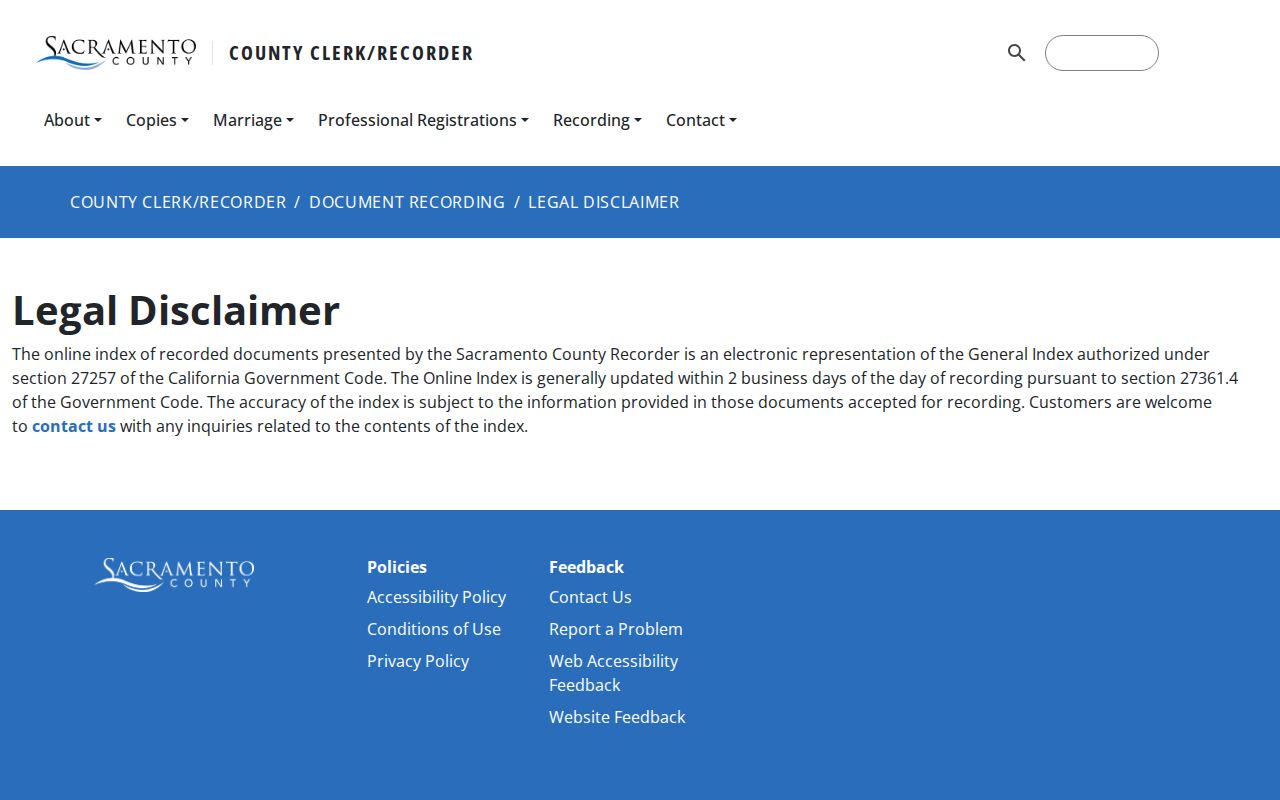
The Recorder’s General Index legal disclaimer describes the index status and its limits.
For previous residents, the 1849 date is the start of a name and document trail, not the date when a particular Citrus Heights house first existed.
Lock the Citrus Heights Address to an APN
Before tracing previous residents, resolve the present address in the Sacramento County Assessor Parcel Viewer. It accepts an address or APN and returns parcel facts such as the APN, situs address, postal city and ZIP, jurisdiction, filed map book and page, block, lot, unit, property description, and the last ownership transfer document. An APN is an assessment locator. It can change after a parcel split and is not a substitute for the legal description in a deed.
The online viewer suppresses the owner name. Use the Assessor lobby computers for secured ownership and name searches, contact the office for the limited general information it gives by phone or email, or request electronic public records through the County’s NextRequest channel. The owner and tax mailing address are different fields. The mailing destination may be a trust, manager, or off-site owner, and it never establishes current occupancy.
Copy the transfer document number and the map, lot, block, or legal-description clues. Those details are more durable than a postal city or a street spelling when a house history reaches into the County era.
Note: An APN helps locate a parcel, but the recorded legal description controls the deed chain.
Tracing Citrus Heights Owners Backward
Once the parcel is fixed, walk the chain of title backward from the current secured owner. Use the most recent transfer reference first. Compare parties, dates, document type, APN, and legal description at every step. A later deed may change an APN or use a trust name, so preserve the recorded wording instead of forcing every result into a modern address.
- Record the current APN, situs and mailing fields through the Assessor’s lawful access channel, along with the last transfer document shown on the parcel card.
- Search the Recorder index for that document number or the current grantee, using a tight recording-date range and the correct document type.
- View or order the instrument and note grantor, grantee, recording date, execution date, vesting, and full legal description.
- Search the grantor as an earlier grantee, then compare the same map, lot, block, parcel, or metes-and-bounds description.
- Repeat until the index, legal description, or custody gap prevents a confident next step. Record uncertainty instead of treating a same-name result as proof.
- Grantor
- The party transferring or conveying the recorded interest.
- Grantee
- The party receiving the interest named in the instrument.
- Chain of title
- The linked sequence of recorded interests that connects one conveyance to an earlier one.
- Legal description
- The recorded land description, such as a lot and map or metes and bounds, used to identify the parcel more precisely than a street label.
Recorded Copies for Citrus Heights House History
The Recorder index is free to search, but a serious house history often needs the instrument. Recorded documents since 1850 can be viewed at either County office. Noncertified copies cost $8 for the first page and $1 for each additional page. Certified copies cost $9 for the first page and $1 for each additional page. In-office self-service uncertified copies are $1 per page.
Use the document number or book and page to order by mail or fax, visit a Recorder counter, or call 916-874-6334 for the copy route. The mail and fax order form asks for title, page count, certified or noncertified choice, book and page, number of copies, contact information, delivery address, and payment. A copy supplies the vesting and legal-description language that an index hit cannot show.
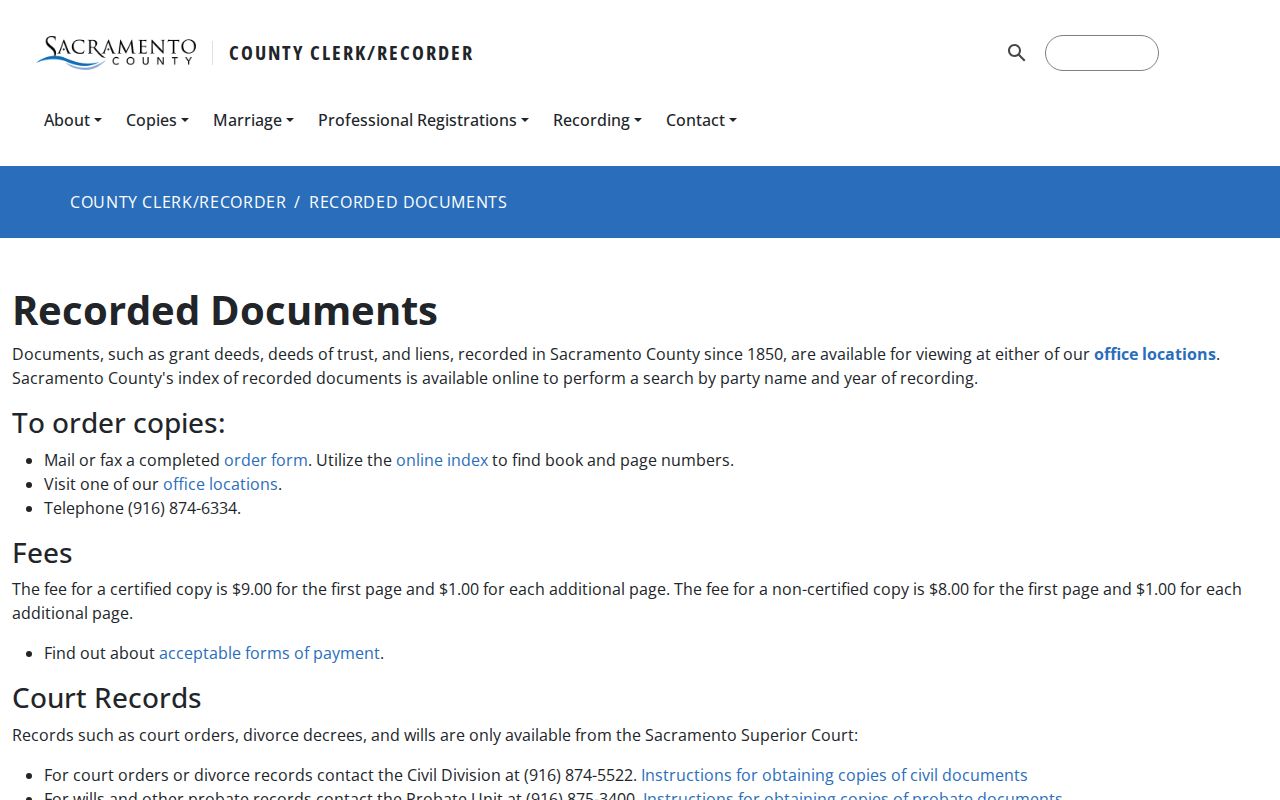
The Sacramento County recorded-document copy page sets out the viewing and ordering channels.
Keep a copy note with the instrument number, page count, and order date so later directory or probate evidence can be tied to the same parcel.
Citrus Heights Directory Years and Shelves
The Sacramento Room confirms city, county, and telephone directory formats but does not publish a complete online year list. Verified points include an 1868 Sacramento County directory and R. L. Polk or Sacramento Directory Company volumes for 1952, 1960, and 1963-1964. FamilySearch catalog entries label some Polk volumes protected or search only, so a catalog hit does not guarantee that a page image can be opened from home.
Before using a city directory for a Citrus Heights address, inspect the title, publisher, included-localities page, and abbreviation key. The area was called Central Township or Sylvan in older records, and “Citrus Heights” became a promotional place name around 1910. A former resident may therefore appear under Sacramento County, Sylvan, or a suburban section instead of a Citrus Heights heading.
The collections themselves, including the Sacramento Room’s vault and local-history access rules, are described on the Citrus Heights city directory page.
Note: A protected catalog entry may confirm a volume without making its page images available from home.
Pairing Directories with Census Years
Directories can place a named person at a street address, while a census can show the household around that person. The federal census is publicly available through 1950 under the 72-year rule as of the research date. The Root Cellar Sacramento Genealogical Society’s 1991 index covers Sacramento County’s 1870 and 1880 census schedules and was published in Citrus Heights.
Use the closest census date rather than assuming that an edition proves an entire decade. A first directory appearance can reflect arrival, delayed listing, or a change in coverage. A disappearance can mean a move, death, marriage, name change, omission, or a boundary shift. Preserve the exact address and enumeration area when the source provides it.
- Copy the directory entry exactly, including initials, spouse notation, address, occupation, telephone information, and any boarder or widow mark.
- Check the nearest released census year and search both surname variants and the address or enumeration district.
- Compare the household’s ages, relationships, and occupations with the directory entry without silently expanding abbreviations.
- Bridge the gap with the next directory, telephone book, deed, obituary, school yearbook, cemetery evidence, or probate file.
- Mark the conclusion as approximate when locality coverage or an address conversion is uncertain.
Citrus Heights Permits and Maps Over Time
Building permits can date construction, additions, rehabilitation, or inspections. They do not date a move-in. The Citrus Heights permit portal is account-associated: a logged-in user can work with an open project, but no unauthenticated address-wide historical search was verified. Request an identifiable address file from the City Clerk when the portal does not expose the needed history.
Older permits and planning files may be County records because city government did not exist before 1997. The Sacramento Room holds local maps from the 1880s to the early 2000s, and library genealogy resources include a Digital Sanborn collection dated 1867-1970. No authoritative Citrus Heights-specific Sanborn sheet was verified, so do not claim a building footprint from the collection until the exact sheet is found.
The City’s public-records route can be used for a normalized address, APN, date range, permit history, planning file, or code record. The research also found no verified citywide street-renumbering event or year. Compare APNs, filed maps, road names, and legal descriptions case by case.
Use the Citrus Heights Building and Safety page for the account portal and the City Clerk public-records page for the fallback request.
Probate and Obituaries End the Trail
An obituary can connect a former resident to a death date, relatives, cemetery, later address, or organization. It is a lead, not a complete civil record. The Sacramento Room’s newspaper resources and local-history collections are useful starting points, while Sylvan Cemetery evidence can add early family clusters when paired with a certificate, deed, or probate file.
Probate belongs to Sacramento Superior Court, not the Recorder. A probate index or public filing may identify a decedent, petitioner, executor, heir, notice, or order. The Probate Unit can explain copy access at 916-875-3400. Confidential guardianship, conservatorship, sealed, juvenile, adoption, and other protected material remains restricted. A will or estate filing can close a former-owner trail, but it does not prove who occupied a property every year.
Search the Sacramento Superior Court public case portal for the county court layer, then verify whether the desired filing is public and whether a courthouse request is needed.
Note: An obituary or probate filing can connect relatives and dates, but neither fills every occupancy gap.
Why 1997 Changes Citrus Heights History
Citrus Heights incorporated effective January 1, 1997, after residents pursued cityhood for years and voters approved incorporation in 1996. That transition is a custody line. Current council, clerk, planning, permit, and public-record files are city-created, while foundational deeds, assessments, voter registrations, maps, and older planning material usually trace to Sacramento County.
Older records may use Rancho San Juan, Central Township, Sylvan, Sylvan District, or Sylvan Corners. The Citrus Heights promotional name dates to the Trainor and Desmond subdivision campaign around 1910. Search the old place names alongside road, school, cemetery, and map references. A modern city boundary does not rewrite the label used when a record was made.
The City’s incorporation history is useful context for choosing the County or City custodian.
Citrus Heights Past Households
Previous residents are the household layer between ownership events. A deed may show a seller and buyer, while a directory, census, obituary, school publication, or permit may identify someone who lived at the address without holding title. Even then, publication dates and coverage rules matter. A listed subscriber is not every household member, and a gap is not proof that the house was empty.
For family history, reconnecting with a former classmate, or an estate question, preserve a source log with the address, page, year, archive, and uncertainty. Use two independent anchors before joining records: APN and legal description, name and middle initial, household relationship and date, or deed and obituary. Stop when the source becomes confidential or the parcel cannot be matched.
Lawful house history. Citrus Heights previous-resident research belongs to genealogy, family history, estate work, and personal curiosity. Do not use a past address or living person’s record trail to stalk, harass, intimidate, trespass, or cause harm.