
Citrus Heights City Directory Holdings
The strongest verified shelf is regional rather than a neat Citrus Heights run. The Sacramento Room confirms city, county, and telephone directories, but its current collection page does not publish an exhaustive year list. Catalog evidence separately confirms a 1868 Sacramento County directory and R. L. Polk or Sacramento Directory Co. volumes for 1952, 1960, and 1963-1964. Those points should stay distinct from any claim of continuous publication.
| Collection | Verified years | Where held | Access |
|---|---|---|---|
| Sacramento Room city, county, and telephone directories | Exact list not posted | Central Library, 828 I Street | Room use; email ahead for vault items |
| R. L. Polk and Sacramento Directory Co. volumes | 1952, 1960, 1963-1964 | FamilySearch Digital Library; other holdings require checking | Protected, search-only records require login |
| Sacramento County directory reprint or extract | 1868; pages 253-312 in a 1988 publication | FamilySearch catalog | Inspect the copy record and address coverage |
| Regional school yearbooks | More than 100 titles | Sacramento Room | Room use; request the title list |
| Local maps | 1880s to early 2000s | Sacramento Room | Room use for roads and subdivisions |
| Genealogy databases | Sanborn 1867-1970; Newspapers.com 1690-2025; HeritageQuest records to the 1700s | Library genealogy portal | Library card access; coverage is collection-wide |
FamilySearch labels the Polk volumes “Protected (search only),” so a catalog hit does not promise a page image at home. The California State Library research guide points to a specialized city-directory database whose printed link was obsolete when checked. Staff or catalog confirmation is the sound fallback for an unlisted year. No source found here proves a final printed year, an uninterrupted run, or an actual Citrus Heights resident line.
The Sacramento Room collection description gives the clearest view of the physical local-history shelf. Its stated holdings make a directory volume one layer among maps, photographs, manuscripts, pamphlets, and organizational papers.
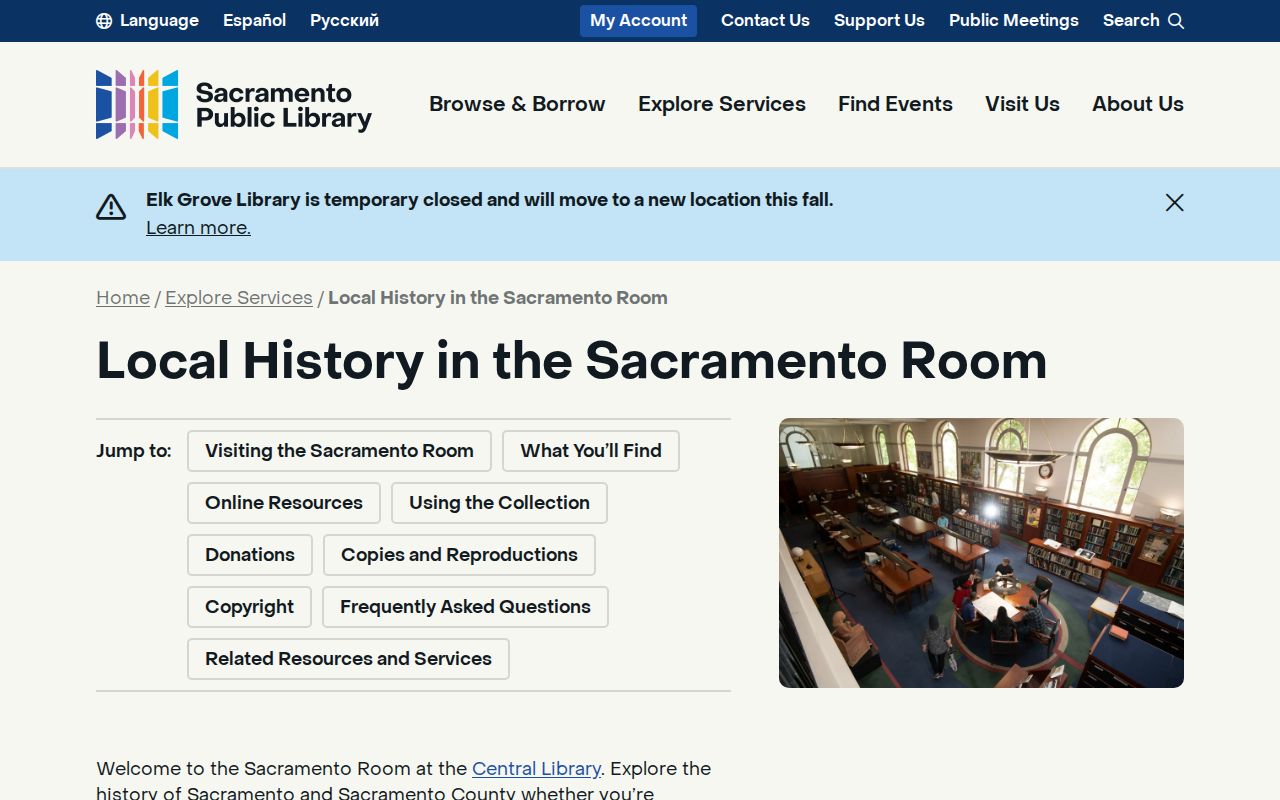
The image belongs with the shelf question: a researcher should ask for a title and year, not assume that a broad regional label includes every Citrus Heights road. Staff can confirm the volume's included-localities page before a search begins.
Citrus Heights Directory Geography
A Citrus Heights city directory entry may be filed under a place that no longer appears on a map. The present-day locality was part of Sacramento County's Central Township and the Rancho San Juan grant. After the Sylvan School began in 1862, Sylvan and Sylvan District became useful local labels. Trainor and Desmond promoted the name Citrus Heights around 1910. The area stayed unincorporated until January 1997, when cityhood created a new municipal record boundary.
Search a volume's locality notes for Central Township, Sylvan, Sylvan Corners, Sacramento County, and Citrus Heights. A Sacramento city directory may focus on the incorporated city and selected suburban areas, while a county directory or telephone book may be the better fit for a rural address. The city history record for the incorporation era helps explain why older entries usually belong to county custody rather than a Citrus Heights city series.
Road names can be steadier clues than the modern city label. Auburn Road, Greenback Lane, Old Auburn Road, Sylvan Road, San Juan Avenue, and Fair Oaks Boulevard connect older maps to later listings, but a road reference alone does not prove that a volume covered the whole present city.
Sacramento Room Citrus Heights Directories
The Sacramento Room is in the Central Library at 828 I Street, on the second floor in the original 1918 Carnegie Reading Room. The collection does not circulate. Visitors sign in, use lockers for belongings, and may bring laptops, notebooks, and pencils. Food and drink stay out. Staff scanning or photocopying depends on condition, while many Digital Collections images can be downloaded free. High-quality scans use an order process, and fragile or large material may not be scannable.
Email ahead with a surname, an approximate year, an old road, and the likely label Sylvan or Citrus Heights. Staff recommend advance notice because some directories, maps, and manuscripts are in vault storage. Vault items need a Sacramento Public Library account, are issued one at a time, and may be photographed without flash. That small preparation step can turn a broad shelf visit into a focused city directory search.
A Sacramento Room directory is a publication snapshot. It can add an address, spouse notation, business, telephone entry, or abbreviation, but it cannot by itself establish current residence. Keep the title page, locality page, and abbreviation key with each note so a later reader can see what the source actually covered.
Reading a Citrus Heights City Directory
The inspected 1960 catalog record identifies a 1,798-page R. L. Polk volume, but its protected status prevented inspection of an actual Citrus Heights line. That limit matters. Directory conventions can guide a search, yet the chosen volume's own key controls. Common entries center on a head of household and may add a spouse, occupation or business, street address, and later telephone information. Initials should remain as printed.
| Name | Printed head-of-household name, including initials and spelling exactly as shown |
|---|---|
| Family notation | Parentheses may identify a spouse, but the volume's key must confirm the meaning |
| Occupation or business | A directory clue that can connect a name to a shop, trade, or public role |
| Address | House number and street, with residence or boarder notation where printed |
| Owner or renter mark | Use only when the selected run defines a symbol or letter for that status |
- Criss-cross directory
- A street-order section that moves from an address to a listed occupant or subscriber. Coverage must be checked for each volume.
- Householder index
- A name-centered index aimed at household heads. It is not a list of every person who lived at an address.
- Abbreviation key
- The volume's legend for marks such as residence, boarder, widow, spouse, or business. Photograph or transcribe it first.
A mark such as “b.” may mean boarder in directory indexing guidance, while parentheses often indicate a spouse. Neither expansion should be treated as certain until the selected volume's abbreviation page supports it.
Citrus Heights Directory Tools
Online access is a mix of catalog discovery and library-licensed databases. The California State Library guide says to query Sacramento in its specialized city-directory and telephone-book resources, but the database link printed in that guide was obsolete at the time of review. The practical next step is staff or catalog confirmation rather than a guess about a missing year.
The Sacramento Public Library genealogy portal brings several useful companions together. It describes Digital Sanborn Maps dated 1867-1970 across the vendor collection, not a verified Citrus Heights sheet; Newspapers.com World Edition coverage advertised as 1690-2025; and HeritageQuest access to more than 4.4 billion records dating to the 1700s. A library card is required for those licensed resources.
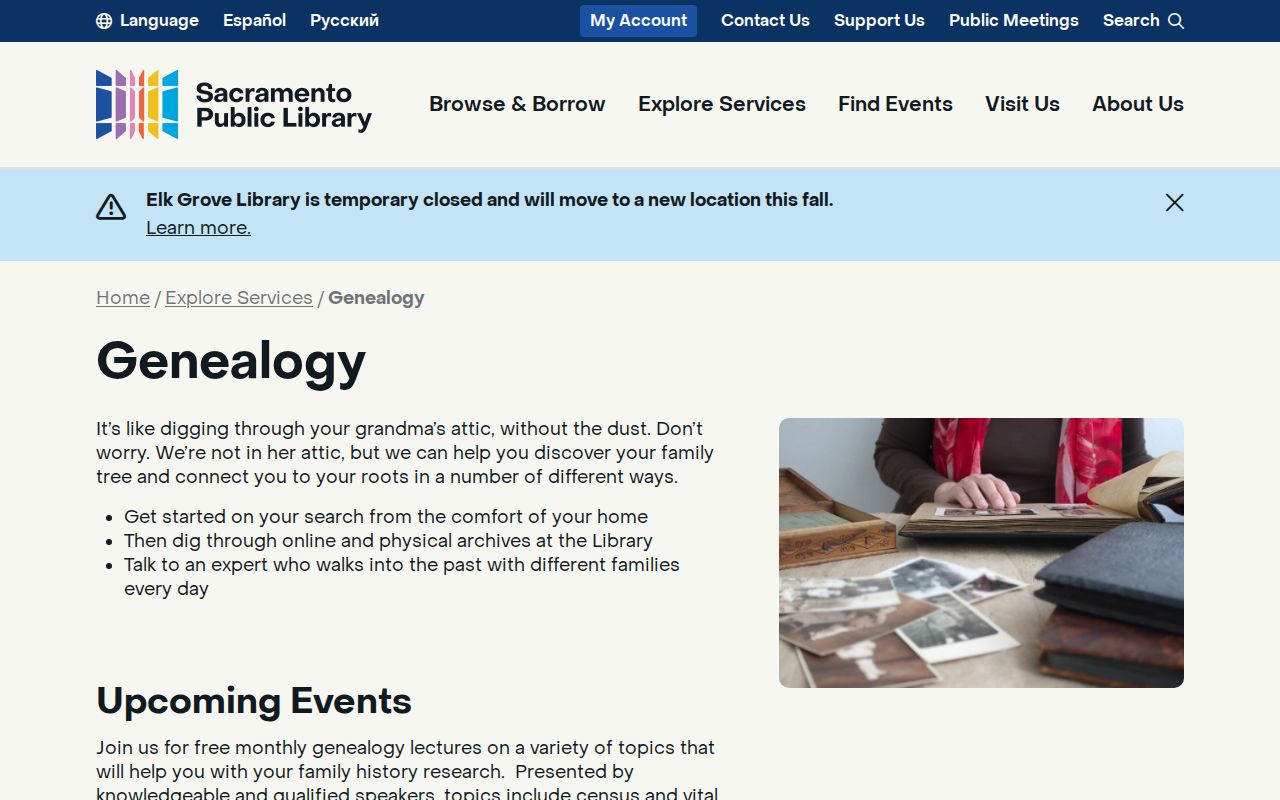
Those tools answer different questions. A newspaper search can locate a Sylvan notice or obituary, a Sanborn map can help test a building footprint when a local sheet exists, and HeritageQuest can bridge a known name to census or directory material. None turns a broad database label into proof of a Citrus Heights resident entry.
The 1991 Root Cellar Sacramento County index of the 1870 and 1880 censuses is another bridge. It was published in Citrus Heights and can help locate a name before the city existed. Use the catalog record for that census index to confirm the item, then pair its result with the underlying census schedule when available.
The 2025 Sacramento Archives Crawl linked the California State Archives, California State Library, Center for Sacramento History, and Sacramento Room through tours and special-collection presentations. Its official event record offers a timely escalation route for a Citrus Heights question that crosses printed directories, county records, and manuscript history. It does not establish a missing directory year.
Trace Citrus Heights City Directories
A household trail works best when each city directory entry is treated as a dated clue. Begin with a known name, address, deed, obituary, school record, or census. Keep the source's uncertainty visible. A first appearance can reflect a new listing rather than an arrival, and a disappearance can mean a move, death, marriage, a changed name, omission, or a boundary change.
- Search the catalog for Sacramento County, Sacramento, Sylvan, and Citrus Heights, then inspect the volume's included-towns page.
- Record the alphabetical entry exactly, including initials, spouse notation, occupation or business, address, telephone, and any residence or boarder mark.
- Check the street or criss-cross section, where one exists, to test an address-to-occupant lead that a name index missed.
- Compare adjacent editions and note every address change, new household member, spelling change, and gap without calling a gap proof of a move.
- Pair the run with the closest federal census from 1900 through 1950, plus the 1870 and 1880 Sacramento County index, to test relationships and ages.
- Bridge a remaining gap with a telephone book, map, school yearbook, obituary, cemetery record, probate file, deed, or assessment clue.
San Juan High School and the Sylvan school system can supply a useful name anchor when a family appears in no city directory. Published yearbooks are distinct from restricted student records. Sylvan Cemetery, established in 1862, can add family clusters, but a gravestone should be checked against an obituary, vital record, probate file, or deed.
Citrus Heights Directory Timeline
The timeline below marks verified record or place-name points. It does not fill the years between them.
| Period | Verified point |
|---|---|
| Before 1862 | Central Township and Rancho San Juan are the useful geographic labels |
| 1862 | Sylvan School begins, supporting the Sylvan and Sylvan District names |
| 1868 | Sacramento County directory is verified in the FamilySearch catalog |
| Around 1910 | Trainor and Desmond promote Citrus Heights through subdivision activity |
| 1952 | R. L. Polk or Sacramento Directory Co. volume is verified |
| 1960 | R. L. Polk volume is cataloged at 1,798 pages |
| 1963-1964 | Another R. L. Polk or Sacramento Directory Co. volume is verified |
| January 1997 | Citrus Heights incorporation creates the modern city record boundary |
Sylvan Stories in Citrus Heights Directories
The local story changes how a name is read. The 1862 school served as an educational, civic, social, and religious center, while Sylvan Cemetery began in the same era. A household can therefore surface in school, church, cemetery, map, and county sources even when it is absent from a Sacramento city directory. The 1910 promotional name change then made Citrus Heights more likely to appear in later advertisements, deeds, newspapers, and suburban listings.
Old Auburn Road and Greenback Lane offer geographic anchors through those shifts. A directory search that starts with only the modern city name can miss the same family under Sylvan or Sacramento County. The safest interpretation joins the printed line to a road, date, map, and independent record.
Citrus Heights City Directory Limits
A city directory is a publication snapshot, not a full resident roll. It may list a household head, subscriber, business, or selected suburban address and leave out renters, children, rural households, protected people, or a whole locality. A protected catalog record is not an image, and a missing year is not proof that no one lived at an address. The verified Polk points do not establish a continuous run.
Use an entry as a lead. Confirm identity with a census, deed, probate file, obituary, cemetery record, or another dated source. When a historical name needs a modern record check, the Citrus Heights resident lookup follows one-person corroboration. When the question shifts to current address-keyed evidence, the Citrus Heights street directory keeps the parcel and street method separate from the historical shelf.