
How Citrus Heights Residents Are Found
Citrus Heights sits entirely inside Sacramento County, and Sacramento is the county seat. That single fact decides where the useful records live. The city produces its own municipal files. But the county holds deeds, assessment rolls, voter files, vital records, and many older planning series. Sacramento Superior Court handles local state cases. State offices add licenses, business entities, custody searches, and privacy programs. No single Citrus Heights residents directory lists everyone in the city. So the work means linking records. Start by separating ownership from residence. An assessment roll ties a parcel to a secured owner and mailing address. Yet that owner may live elsewhere. A deed records a transaction, not occupancy. Voter lookup exists for voters checking their own files. A directory or census entry is just a dated snapshot. A short verified chain beats a long list of maybes.
- Normalize the address, then enter it in the county parcel viewer to confirm the APN, jurisdiction, postal city, and transfer reference.
- Use the Sacramento County Assessor records channel, lobby computers, office contact, or a scoped NextRequest request for the public owner and mailing fields that the web viewer omits.
- Take the latest transfer document number or book and page into the Sacramento County Recorder index to connect the parcel with parties and a deed trail.
- Use My Voter Status only for the voter who can supply the first name, last name, date of birth, and identity match. Do not treat it as a street roll.
- For an older household, search the Sacramento Room, reverse directories, census indexes, newspapers, and cemetery or obituary evidence under both Citrus Heights and older labels.
- Compare two anchors, such as an APN and a middle initial, before treating a name as the same person. If a city-created record is identifiable but not online, make a focused CPRA request.
Addresses also anchor any street-by-street project. The Citrus Heights street directory workflow keeps parcel, deed, permit, and historical address evidence in a sensible order for a residents directory search.
Citrus Heights Resident Records Offices
The custodians sit across Sacramento County and California. The Sacramento County Clerk/Recorder keeps recorded instruments and vital-record functions. The Assessor holds the assessment roll and parcel data. Voter Registration and Elections handles voter-file requests, and the Secretary of State runs the authenticated My Voter Status service. City Hall keeps records created by Citrus Heights itself, mainly from incorporation forward.
Each office answers a different question for a residents directory. A recorder entry names parties to an instrument. An assessor parcel links land, map data, values, and a recent transfer reference. Elections data is purpose-limited. City Clerk files can reveal a public meeting, permit request, campaign disclosure, or city agreement. The cards below gather the main public starting points.
Sacramento County Clerk/Recorder
3636 American River Drive, Suite 110
Sacramento, CA 95864
916-874-6334
Recorded Documents Index
Sacramento County Assessor
3636 American River Drive, Suite 200
Sacramento, CA
916-875-0700
Assessor Records
Sacramento County Elections
7000 65th Street, Suite A
Sacramento, CA 95823
916-875-6276
My Voter Status
Note: Sacramento is the county seat, but the Citrus Heights City Clerk holds city-created records from incorporation forward.
Why Citrus Heights Parcel Viewer Hides Names
The Sacramento County Assessor Parcel Viewer is the best free first step for an address. It is not, however, an online owner-name search. Its public card displays an APN, address, postal city and ZIP, and jurisdiction. Map and lot or block fields appear too. The card also shows values, land-use codes, property characteristics, and a last ownership transfer document. The owner or assessee name is deliberately suppressed online. Owner and mailing-address information remains public through other channels.
Follow the Assessor records guidance for the access rule. Then request only the narrow field needed. Lobby computers at 3636 American River Drive, Suite 200 support secured ownership and name searches. The office answers general questions for no more than two parcels per contact. That limit applies per phone or email contact each day. A free electronic request through the county's NextRequest channel is another route. A visible homeowner exemption is an occupancy clue only. It does not prove the owner, or anyone else, lives there.
The parcel card matters for a Citrus Heights residents directory because it bridges to the Recorder. Copy the document number before leaving the viewer. Note the event date as well. Also record the filed map book and page, lot, block, unit, and legal-description fields.
For a visual starting point, the Sacramento County Assessor records page explains which fields are public. It also shows which fields stay off the Internet display.
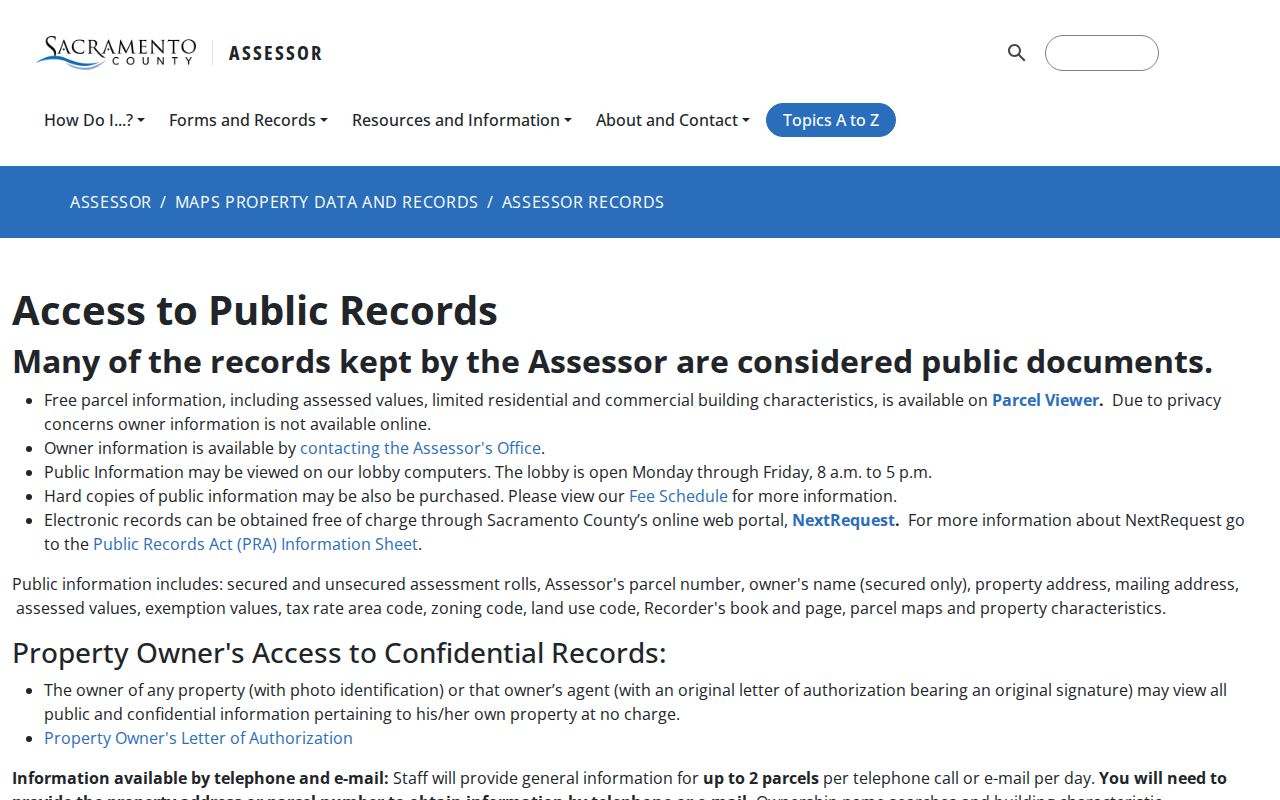
The image underscores the core rule for a Citrus Heights residents directory. A free parcel result is a map and roll clue, not a public web roster of owners.
| Parcel Viewer field or control | What it does |
|---|---|
| Search box | Accepts a property address or APN in one omnibox. |
| Map click | Lets a researcher zoom to a street and select a parcel. |
| Parcel Details | Shows the selected card, including APN, jurisdiction, map, lot, block, and transfer reference. |
| Select Parcels | Offers Point, Line, Rectangle, or Custom selection, with an optional distance buffer. |
| Measure | Estimates distance, area, or coordinates and is not legal or engineering work. |
| Owner name | Suppressed online; use the lobby, office contact, or a properly scoped public-record request. |
The Citrus Heights Recorder Since 1849
The Sacramento Clerk/Recorder's electronic General Index reaches back to documents recorded since 1849. It is an index only. No instrument image appears online. Vesting language stays in the deed. The County updates the index within two business days. That makes it work well for checking a recent transfer reference after the parcel step.
Search options are broad. Party name works. So do document date or range, document type, title, document number, and book and page. The trail can include deeds, deeds of trust, reconveyances, assignments, and liens. Once a result appears, order or view the instrument through the County. Recorded documents are viewable from 1850 forward. The index date and the copy date differ.
Use the parcel card's document number when you have it. If it is missing, search the named parties within a tight date range. Compare the legal description. A deed connects a grantor and grantee to a recorded interest. It does not prove occupancy. The Sacramento Recorder index overview is the official entry point for coverage and image limits.
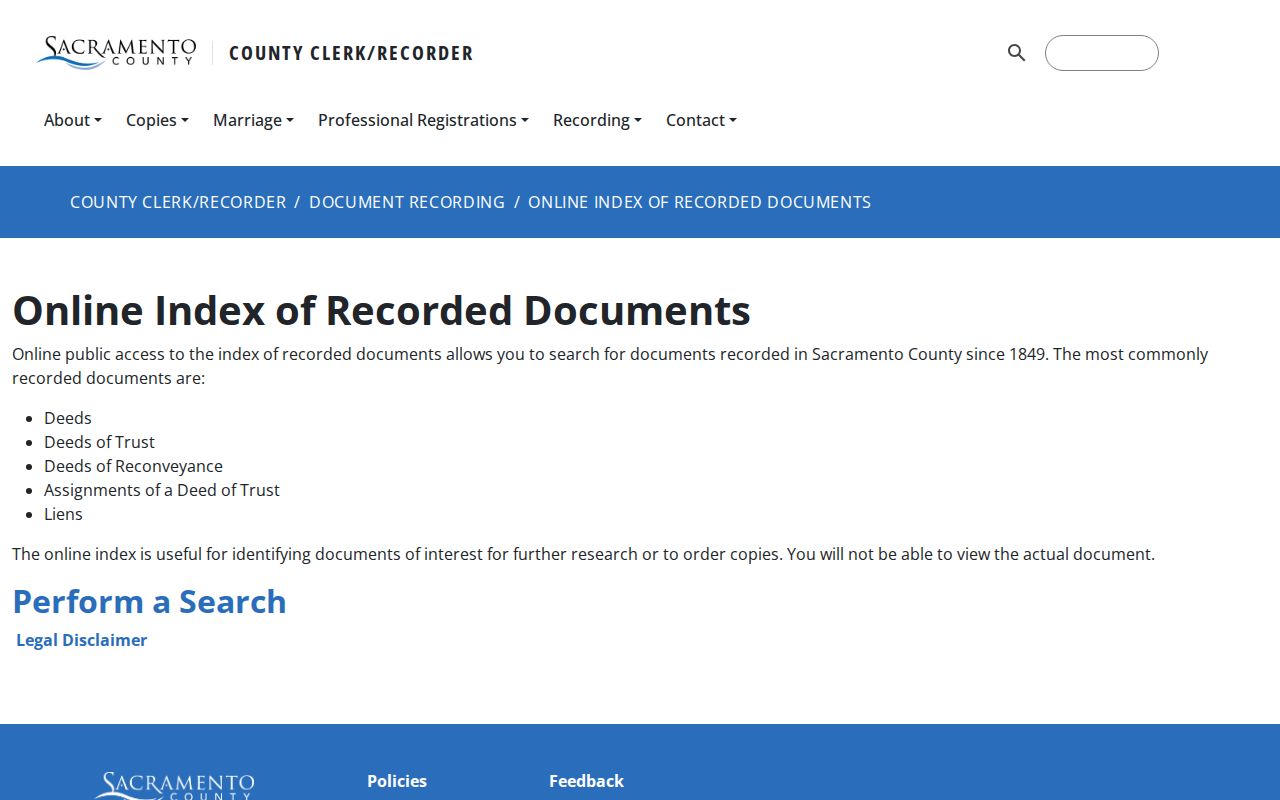
That index-only design carries a practical lesson. A solid Citrus Heights residents directory workflow pairs a free index result with the ordered or viewed instrument before any family-history or property conclusion. An entry alone cannot carry the weight. Note: The index can locate an instrument, but only a viewed or ordered document supplies its full legal description and terms.
Current Citrus Heights Resident Directories
Think of current records as a coverage map. The Assessor can identify a secured owner, but only through an office channel. The Recorder shows a party to a recorded transaction. Voter service confirms your own registration. City, state, and vital-record indexes add narrower affiliations or events, but none of them turns an office address into a residence.
| Source | What it can confirm | Keeper | Access level |
|---|---|---|---|
| Secured assessment roll | Owner, situs, mailing address, APN, values, exemptions | Sacramento County Assessor | Owner name through office or request, not the web card |
| Recorded-document index | Parties, instrument type, recording date, document or book-page reference | Sacramento County Clerk/Recorder | Free index, image or copy through the office |
| My Voter Status | One voter’s status, address, precinct, ballot and party details | California Secretary of State | Authenticated self-lookup |
| City Clerk records | Names tied to public city business, permits, meetings, or filings | Citrus Heights City Clerk | Online request, PDF request, or City Hall inspection |
| Vital certificates | Birth, death, and marriage events, subject to copy rules | Sacramento County and CDPH Vital Records | Informational or authorized copy, depending on eligibility |
| Historical collections | Past households, affiliations, schools, newspapers, and local context | Sacramento Room and repositories | Room use, library databases, or collection-specific access |
- Roll
- An official list or account, such as an assessment roll, that records a defined class of people, parcels, or values.
- Index
- A finding aid that points to a record or instrument but may not include its image or full terms.
- Parcel
- A County assessment unit identified by an APN and tied to map, address, and legal-description clues.
- Criss-cross directory
- A historical reverse directory arranged by street or address rather than only by surname.
A match holds up when the source answers the question it was built for. Compare dates, addresses, relatives, or an APN. Stacking names from unrelated rolls proves little. For a past household, move to the historical shelf and treat each edition as a snapshot.
Birth, death, and marriage copies have their own rules. The California Department of Public Health Vital Records page separates informational copies from authorized certified copies. Confidential marriage records fall under a separate county-clerk rule.
Note: A My Voter Status nonmatch is not proof of nonregistration because confidential records and identity mismatches can block retrieval.
My Voter Status in Citrus Heights
My Voter Status is a self-lookup tool. It is not an open Citrus Heights voter directory. California's service asks for the voter's first name, last name, and date of birth. It also needs a driver license or identification number, or the last four digits of a Social Security number when the live prompt requests it. A nonmatch can stem from spelling. It can also stem from a recent registration, a confidential record, or an identity-field mismatch.
A successful lookup reveals plenty. It shows registration status, party preference, and voting address. It also lists precinct and election information, a Vote Center or polling assignment, and current ballot status. It never builds a street-wide resident list. Sacramento County voter-file access is a different animal. That request needs an application, identification, payment, and a permitted purpose. Released voter data can include name and residence and mailing address. It can also include party, precinct, district, and participation history. Ballot choices, driver-license data, Social Security numbers, and signatures are withheld.
See the My Voter Status authentication form for required fields.
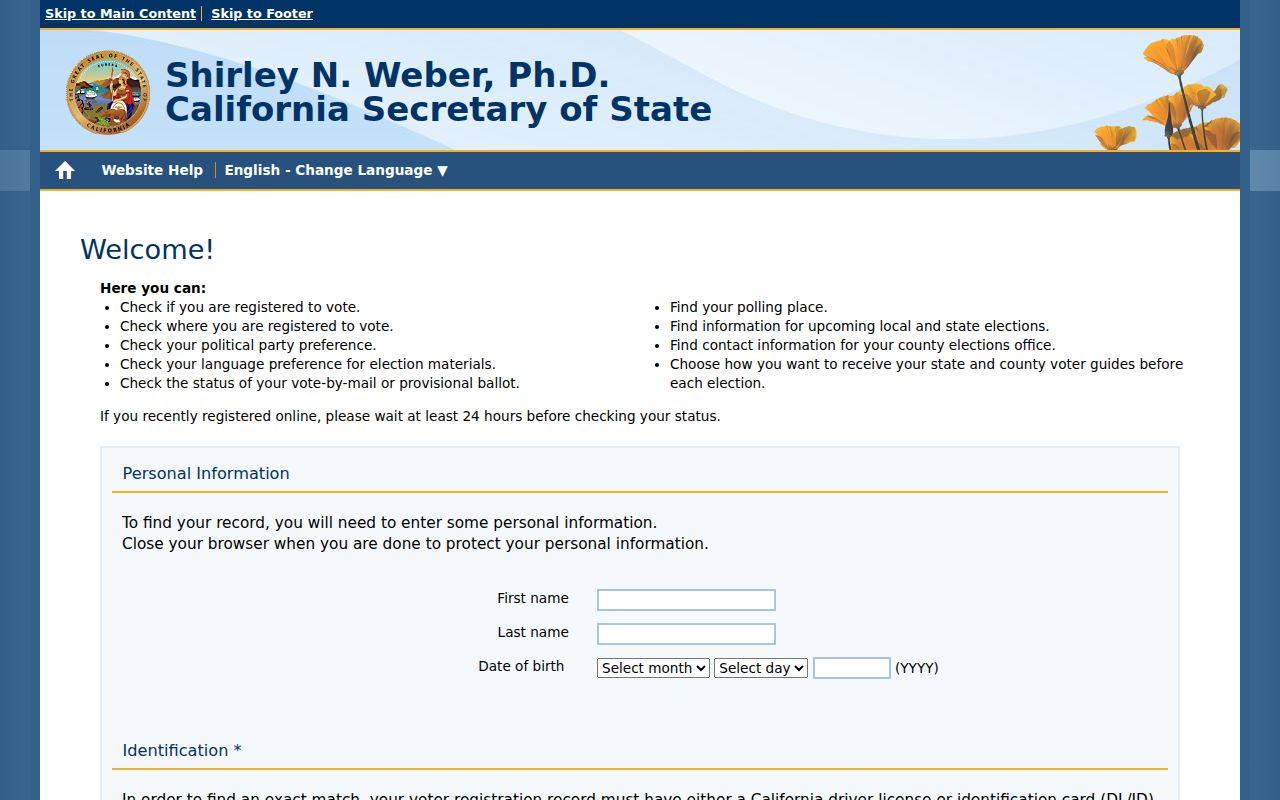
For a Citrus Heights residents directory, the state tool draws a useful boundary. Self-service verification and authorized voter-file release are separate channels.
| My Voter Status field | Purpose |
|---|---|
| First Name and Last Name | Matches the voter’s registration identity. |
| Date of Birth | Supports identity authentication. |
| California driver license or ID number | One identity-match route when requested by the service. |
| Last four Social Security digits | Alternate or additional identity-match route when requested. |
| Submit | Runs the authenticated self-lookup. |
Sacramento Court Context for Citrus Heights
Court matters in Citrus Heights have one home. Civil, probate, family, criminal, small-claims, and traffic cases all belong to Sacramento Superior Court. That court is the county's unified trial court. No statewide party search replaces the county index. The court portal covers civil and probate material through public access routes. Criminal filings go back to 1989 on the criminal portal.
Remote access is narrower than courthouse access. Criminal, family, small-claims, and other sensitive results carry limits. The display may show only a case number, a filing date, and participants. Some kiosk records never reach the web. California Rule of Court 2.503 governs that split. Confidential, sealed, juvenile, adoption, and protected guardianship material stays restricted. A matching name is not a fingerprint identification. And a court result is not a complete history.
Use Sacramento Superior Court Public Case Access for the county search. Verify a result against the clerk or courthouse file when the remote display is incomplete.
Citrus Heights City Hall Records
City Hall mostly guards records created after Citrus Heights incorporated. The City Clerk holds ordinances, resolutions, agreements, and minutes. Campaign-disclosure statements, Statements of Economic Interests, permits, and inactive or permanent records in the City Records Center round out the holdings. Those files tie names to public city business. They are not a municipal residents list. Police reports take a different path, resting with the Citrus Heights Police Records Unit rather than the Clerk.
Building and Safety files need extra care. The customer portal lets an account holder apply for a permit, track a project, schedule inspections, and upload documents tied to that account. The city publishes no unauthenticated, address-wide permit-history search. For an older address, ask the City Clerk for a disclosable permit, planning, code, or inspection record. Name the address, APN, record type, and date range.
The Citrus Heights public-records page serves as the city custodian's access map. It also explains why pre-1997 research usually starts with Sacramento County instead of a city file.
Historical Citrus Heights Directories
The historical wing of the Citrus Heights residents directory is a shelf problem, not one search box. Sacramento Room holdings span city, county, and telephone directories. Maps, photographs, newspapers, yearbooks, manuscript collections, and organization periodicals round out the shelf. A verified 1868 Sacramento County directory anchors the early era. Confirmed R. L. Polk and Sacramento Directory Company points fall at 1952, 1960, and 1963-1964. Those are scattered volumes, not a continuous run.
Names changed over time. Present Citrus Heights was tied to Central Township and the Sylvan or Sylvan District label before the promotional name caught on around 1910, and the area stayed unincorporated until January 1997. Search Sacramento County, Central Township, Sylvan, and Citrus Heights. Then read a volume's included-localities page before assuming rural coverage. An entry may list a head of household, address, spouse notation, occupation, or telephone detail. An omission never proves a household was absent.
The Citrus Heights city directory collections explain how to work the Sacramento Room shelf. Take it volume by volume. One uncertain index hit should never harden into fact.
Citrus Heights Historical Networks
Some of the best past-resident clues grew from institutions rather than a city directory. More than 100 regional yearbook titles wait in the Sacramento Room. San Juan High School and Sylvan school material sits among them. Yearbooks name people directories miss. The 1991 Root Cellar Sacramento County index covers the 1870 and 1880 federal censuses. It was published in Citrus Heights. Sylvan Cemetery, begun in 1862, can add family clusters. Pair it with an obituary, death certificate, probate file, or deed.
The Citrus Heights Historical Society preserves local narratives and photographs. City Hall historical publications cite the 1885 Sacramento County map. They also cite the unpublished 1943 Sylvan Recollections. These are leads and context. They are no substitute for a recorded document. Use the Sacramento Room for the physical shelf. The library's genealogy resources carry licensed newspaper, census, Sanborn, and directory databases.
Note: Email the Sacramento Room before a visit. A directory, map, or manuscript may sit in vault storage.
Official and Commercial Directory Clues
Official free sources have a keeper and a limit. Commercial people-finders blend public and licensed data, and that blend can go stale. Such a site may merge people with similar names. It may mislabel relatives, or hide its source trail. Treat it as a lead at most. A family-history question, an heir search, or a public business affiliation check belongs at the primary office. Let the keeper's record settle the conclusion before it stands.
| Source category | Useful clue | What must be checked |
|---|---|---|
| County and state records | APN, owner channel, deed party, voter self-status, license, or entity | Custodian, date, access rule, and whether the clue concerns ownership, identity, or residence |
| Library and archive collections | Past address, household, school, cemetery, newspaper, or community link | Edition, included locality, page image, and abbreviation key |
| Commercial search category | Possible name or address lead compiled from multiple datasets | Source provenance, freshness, false matches, and lawful personal use |
The strongest comparison is not free versus paid. It is primary record versus unverified compilation, because only the first has a keeper who can explain what each field means.
Citrus Heights Business Search Records
Business and professional records can separate people who share a name. An agent or office address is an affiliation. It is not proof of a home. California Secretary of State bizfile Online searches an entity name or file number. A result can show entity name and number, type, formation or registration date, status, jurisdiction, addresses, agent, filing events, and recent PDFs. Search is free. Certificates and some account functions follow separate rules.
Use the California business entity search for the legal-entity layer. The Department of Consumer Affairs license search works by board, license type, number, business name, first name, last name, registry number, city, or county. Several boards run separate systems, though. Fictitious-business-name filings stay with the County Clerk/Recorder. Keep the person's role attached to every result. Keep the filing date attached too.
The California business entity search page displays the right kind of record for a Citrus Heights residents directory: an entity trail with named roles, not a claim that an agent or officer lives at the listed address.
Entity results can support an identity comparison beside a parcel, deed date, license status, or historical entry. The business record itself answers an affiliation question.
Citrus Heights Custody Search Limits
Custody lookup and a residents directory answer different questions. The Sacramento County Sheriff inmate information page covers the county jail system only, searching by name or XREF number, and it points to a state-prison locator once a custody question leaves Sacramento County. California Megan’s Law sits apart as well. It is a public subset of the sex-offender registry, and statute sets its posting categories along with limits on how the data may be used.
Never read either result as a residence claim. A jail hit describes custody today. A state hit belongs to a different system entirely. Megan’s Law shows a full address for some records and only a city or ZIP for others, and it omits certain people by law. Stay within the public-safety purpose the official service states, and keep the exact level of address detail the record displays.

That line matters for the Citrus Heights residents directory. It keeps custody, registry, ownership, and residence from being presented as one interchangeable record type.
Privacy Rules for Citrus Heights Records
Several limits shape any Citrus Heights record search. California's Safe at Home program gives qualifying participants a substitute mailing address. It also provides confidential voter registration. The federal Driver's Privacy Protection Act restricts driver and vehicle records. Utility customer data stays closed. So do private household lists, juvenile matters, adoption records, sealed files, and confidential court material. None of it opens just because a name or parcel is known.
Treat a tax mailing address as a contact clue, never as proof of occupancy. Renters and other household members often never surface in land records. The same caution fits a school yearbook. It also fits a business filing, an obituary, or a court party. Every source has a date, a purpose, and a boundary.
Lawful personal use. Citrus Heights records can support family history, estate work, genealogy, civic research, and personal safety checks. Do not use a name, address, or record trail to stalk, harass, intimidate, impersonate, or harm another person.
A Citrus Heights CPRA Request
The California Public Records Act gives every person the right to inspect identifiable public records, subject to exemptions. The Citrus Heights City Clerk generally decides within ten calendar days whether disclosable records exist, and an unusual case may carry a statutory extension. Ten days is a determination window. It is not a promise that a large production lands that fast.
Submit through the City’s online request route or its PDF form. Name the record, address or APN, department, and date range instead of asking staff to hunt for a person in general. Inspection at City Hall is free. Paper copies run $0.20 per page plus mailing, and electronic or special duplication follows the applicable direct-cost rule. The City Clerk sits at 6360 Fountain Square Drive, Citrus Heights, CA 95621; phone 916-725-2448; fax 916-725-5799; open Monday through Friday, 8 a.m. to 5 p.m. Police records belong with Citrus Heights Police instead.
The form lets you ask for print, electronic delivery, or view-only access, with pickup, email, mail, fax, or another response channel. A focused request works best. A permit history, a meeting file, an address-assignment record, or a disclosed campaign filing beats a broad sweep for every record about a person.
For a historical name or address predating cityhood, send the same question to the County custodian or the Sacramento Room collection that actually holds the series. Custody follows the record and its date. The modern mailing label matters less.
Note: A ten-day determination says whether records may exist; it does not promise immediate production.